


Stranded Knitting on a Desserted Island
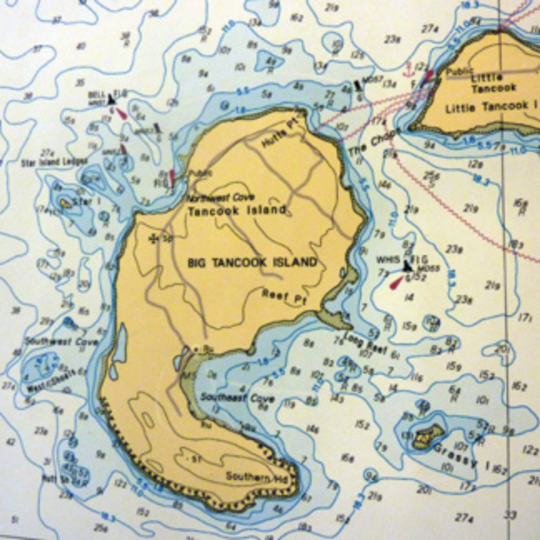
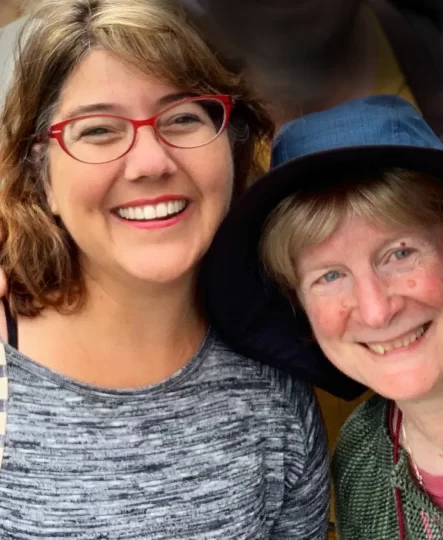
Some islands are deserted, meaning nothing much is there; I had the great good fortune of being stranded knitting with Lucy Neatby on the desserted (plenty of chocolate in the cupboard) Tancook Island, off the Nova Scotian coast near Halifax, where Lucy has a cottage on a hill above the sea. My heart has now put down roots on Tancook and nothing, not even the gale force winds that stranded us there overnight, can ever extract my heart from that mesmerizing three-mile-by-one mile forested rock.
It all started last week when I flew to Toronto to join Stephanie Pearl-McPhee for the flight to St. John, New Brunswick. She and I became jolly and perhaps a bit too insouciant, unaware that we were both botching the knitting projects—Fiona Ellis’ Gwendolyn (Steph) and Sivia Harding’s Confluence Shawlette (me) —that we were attempting to follow using the tried-and-untrue method of glancing at only some of the directions and charts, assuming we “got it.” It got us.
Somewhere at 40,000 feet we each discovered we had overlooked key elements and thus had to unravel hours of work. One knitter gone wrong is sad, but two gone wrong is merry, so when the nice Air Canada flight attendant came along with customs cards, Stephanie happily tucked her passport, pen, and card in her seat pocket and promptly forgot it. You can read all about the result of our merriment here. When I flew out of Halifax early this morning I took the time to tell the Air Canada agent that her company had done something so magnificent for my friend that I probably ought to kiss her feet (Stephanie, on the other hand, you will learn when you read her post, was so monumentally relieved that she nearly kissed her saviour on the other end).
In the tiny St John, NB airport, Veronik Avery and our driver awaited us and we zipped off through beautiful countryside to the charming Algonquin Hotel which spreads like a twisted stitch design atop a promontory in St. Andrews-by-the-Sea for the Knit East Fibrefest, where Jane Thornley and Lucy were also teaching. In the market, Stephanie, still unaware of her lost passport and thus full of mischief, cast a spell on me which caused me to buy hundreds of dollars of Fleece Artist yarn (and an Ilga Leja pattern, which will turn out best if I actually read all the directions) while she spent considerably less. I tried my best to get her to compete with me, but she refused.
Veronik, Stephanie and I traipsed down to the sea to see the unusually high tide (which had been so high an hour earlier—around 26 feet—that the whale-watch office, on stilts, had been ready to evacuate because of waves lapping at the floor), and discovered Cottage Crafts, which enthralled us all and which I shall let Stephanie tell you about here.
My classes, Personal Footprints for Insouciant Sock Knitters, and Magical Moebius Knitting, were full of hardy, capable, adventurous, good-hearted knitters with whom I would be glad to spend my life if I could only be two of me, one a US citizen and the other Canadian. If Cricket Cove ever hosts a second Knit East, I recommend you try to attend.
Meals were great fun because they gave rise to the Drama of the Elusive Cheese Sandwich (DECH). One evening the tall, dark, and handsome server said to Stephanie, when she hypothetically asked if he would bring her a cheese sandwich (with cheese) if she asked for one, “I will bring you anything you ask for,” and she replied, “You will? Why?” and he answered, “Because I’m afraid of you (in a good way).” Alas, the DECH still had a day to go at that point or the denouement might have been different. Spies write with invisible ink, and some chefs ply their trade with invisible cheese.
After the Sunday’s class, Lucy and I made a fast getaway in her Mini in an attempt to outrun the storm that was headed our way. With Lucy masterfully piloting her now amphibious Mini, six hours and two cups of chicken noodle soup later, we made it to Dartmouth, NS. Monday morning we awoke and drove to idyllic Chester, the Tancook equivalent of Anacortes (the ferry terminal I use to reach my home in Friday Harbor, on San Juan Island, just south of British Columbia).
The Tancook Island Ferry can take one car (in Friday Harbor our ferries mostly take over a hundred), and only if the tide is cooperating so that the ferry, dock, and ramp can meet at the necessary levels and angles. There is a huge metal box which is hoisted by crane on and off the boat at each stop, where riders can store anything from a new bed to a bag of groceries for no extra charge.
Here you see the single vehicle, several metal storage boxes, and the red crane as we sail away from Chester. A rider pays $2.05 per round trip (from Anacortes to Friday Harbor it’s nearly $10.00). Inside, there are about 50 comfy blue seats, and you have to stand up to see out the windows because you are low and they are high.
Lucy often teaches a bit of knitting to ferry passengers. The technique du jour was double-knitting. Nearby, four islanders retrieved an old real estate sign from somewhere, propped it on 4 sets of knees, and began a lively game of cards.
When the weather permits (as it did on our trip out) you can go above, and stand at the prow watching the flag flying as you manuever through miscellaneous islands (anything above the high tide mark counts) to Tancook.
Dolphins cavorted starboard for several minutes, and Scott, the ferry guy, when we asked him to take a picture of us, spontaneously laid down on his back on the damp deck to get an interesting angle. What a guy. (Note the shoes I am wearing: 1 blue and 1 green; this will become significant soon).
We stayed above knitting until Little Tancook hove into sight; fifteen minutes or so later we pulled around a windbreak into Big Tancook’s dock where Scott hefted a long pole with a big hook on the end, reached for the dock rope and secured it to the deck.
The gangplank was lowered, the crane (once again operated by Scott) began to lower the huge metal box onto the dock, we descended, retrieved our supplies from the box, and there I was, on Tancook Island at last.
Lucy asked one of the other passengers if we could hitch a ride in the back of their truck. “Of course,” they replied, and as I was climbing in, the wife saw my shoes (Lucy and I have shared a pair of Keens since the first Sock Summit in 2010; we each have 1 green and 1 blue shoe) and she reached out for me like I was long-lost family: “Oh! You’re the one with the shoes!” she cried. And just like that I was part of Tancook Island. We bounced and bumped along the road, me sitting on Lucy’s new zebra carpets and Lucy perched on her duffle, all the way to her cottage, a most refreshing and scenic ride past happy chickens and vegetable gardens.
After a cup of tea, we set off for a hike and I found myself in the midst of a photographic epiphany. The “rule of thirds” activated in my brain and body so that composition became not a thought so much as a rightness, and I now have hundreds of photos that are so much better than anything else I have ever shot. That a latent ability would burst forth like a newborn filly, already walking and running in this feral bit of land in the sea, makes complete sense to me.
That evening we knit on the deck in the misty light that came and went through the fog that kept wanting to drift in and out of Lucy’s yard.
My chair held me up just fine at first.
And then it didn’t. But I kept knitting.
Tuesday morning we boarded the ferry back to meet about 50 Craft Cruise knitters due to arrive at Lucy’s house in two shifts, where they would stream into her basement “shop” (open by appointment only) and scoop up armfuls of beautiful yarns, DVDs (Lucy’s DVDs contain enough crystal-clear instruction, all presented with Lucy’s wit and charm, to keep you deliriously happy for at least a week; I cannot recommend them highly enough, try one and you will see what I mean), books and patterns. I saw some old friends from previous workshops (Hello Vivian and Gretchen!) and met many lovely knitters, all of whom spoke in glowing terms of the cruise. Then we dashed back to the Tancook ferry. We knew a serious storm was brewing but figured if we could make it to Tancook we could make it home the next afternoon after the storm blew itself out. Two of Lucy’s friends were planning to join us, and one backed out because of the storm. When Scott the ferry man came down below to punch our tickets after we were underway, he mentioned that the first ferry of the morning might not run the next day if the wind didn’t let up. How quaint, we thought, and how lucky that we are planning on an afternoon boat (I had a workshop on Thursday, and Lucy had a new sink arriving).
Little did we know that by morning, the combination of fierce wind and very high tides would flood some island roads and all Wednesday ferry runs would be cancelled, something that had not happened in over 27 years.
The most blurry part of the photo is salt spray on my lens, and the whole photo is a bit blurred because the wind was so fierce that I could not hold the camera or myself steady. That’s the ferry tied up there, precariously high alongside the dock because of the high tide and wind surge. The weather report predicted gale force winds continuing through Thursday midnight, which meant I’d miss my workshop scheduled for that day. Lucy decided I could teach via Skype (high speed internet had just been installed in part of the island and we would be able to borrow it). Fortunately, I am still trying to imagine that.
She made some inquiries and the ferry captain phoned us back to say we ought to show up for the 6 am ferry in case it would run. I scavenged enough wild island apples to make a pot of applesauce for dessert and we intarsia’ed together what was left in the refrigerator for supper. Stephanie had been given more fine bottles of beer in St. Andrew than she could take home on the plane and had donated the remainder to us, so we were able to toast our strandedness with a beer called “Dark and Stormy Night.”
Friday morning, 3 hours before I was due to start my workshop an hour and a half across Nova Scotia from Chester, the ferry did indeed set sail with us aboard.
We met Diane, my lovely chauffeur, at Lucy’s friend Jennifer’s Hawthorne B&B in Chester, where the lovely Jennifer and her husband greeted us with freshly ground milk-frothed coffee, coddled eggs, and cinnamon buns. Lucy went home to direct the installation of her kitchen sink (she has been renovating, and her kitchen was in the condition of “everything but the kitchen sink”) while Diane drove me through glorious countryside to Gaspereau Valley Fibres where I alternately taught another fine group of Maritime knitters and wandered through the spacious shop feasting my eyes and hands on everything, petting the cat, cooing at the Cotswold sheep in the adjacent pasture, and enjoying the company of my students.
For lunch yarn shop owner Brenda had arranged for a Sweet Tomato Soup made with fresh tomatoes from the valley farms, in honor of the class I was teaching (Cat’s Sweet Tomato Heel Socks). The day went way too fast; I would have loved to keep my students for many more hours.
Then Diane whisked me back to Lucy’s just in time to join a birthday celebration for Lucy’s just-arrived-from-England sister and brother-in-law. I felt unspeakably glad to be for that night part of her family of exceptionally bright and spirited individuals, so different than one another yet so kindred and living in lively harmony.
How did I ever get to be so lucky as to live this life I am living? Thank you, thank you, thank you.
Padded Sweet Tomato Heel and lovely round hay bales
Summer in the San Juan islands, tucked under the wing of the Canadian Gulf Islands in the Salish Sea north of Seattle, is idyllic. Here’s the ferry terminal in Anacortes (on the mainland) as the sun melts into the water.
In fact, no matter the time of year, anytime I return home I feel so, so lucky to live here. This time I’d been in Portland for ten days, visiting my brother, teaching at Sock Summit, and seeing dear friends.
This is the scene that greeted me when I returned home. Fields of round hay bales and sheep… the island is dotted with these enormous spirals, which dwarf the sheep and resemble yarn-winder-wound balls of yarn, making it appear as if a giant’s knitting basket has tipped over onto the field.
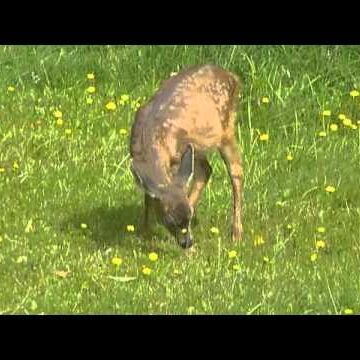
And my fawns are growing tall and strong. The grass needs mowing, except I can’t. Could you mow your dandelions if creatures this beautiful like to nibble at them?
News alert! A fawn just appeared and while it nibbled, I filmed through the window, so you can see that I am telling the truth. Here you are. Believe it or not, I see this sort of enchantment all the time and turn away to get my work done.
Sock Summit in Portland, Oregon, was another wonderful experience just like the first one two years ago. I spent the day before things began with Clara Parkes, researching artisan ice creams, a daunting task to which we devoted ourselves. Until the teacher’s dinner that evening, I had nothing all day but ice cream. Our favorite was Salt and Straw. Their ice cream is so good that I cannot describe it and shall not even try. They have left me in a Pavlovian state; all I have to do is think of them and I salivate. Anyway, after filling ourselves with frozen wonderment, and lingering in one of the sweetest little fabric stores anywhere, Bolt, which happens to be in the same neighborhood as Salt and Straw (okay, I admit it; I dined there twice in one day), we went to join the other 60 amazing teachers for a normal dinner. We skipped dessert.
This pigeon right outside the convention center wore a different cowl every day, clothed by anonymous sock summiteers.
Like the first Sock Summit, there were thousands of intensely brilliant and adventurous knitters all concentrated in one place, sharing ideas, fondling one another’s clothing and projects, buying delicious yarn and tools and bags, and filling classrooms with so much devotion and brightness that we scarcely needed electric lights. I taught three single days of a class called “The Knitting Sleuth” for knitters with a forensic (investigative) bent, where we examined my library of thrift store sweaters cut up and framed into forensic samples. I even had a real live topologist in one class, and also a textile engineer – be still my heart! Here are photos of my students dissecting samples, seeking insights that might let their yarn and needles dance and create textures that have never before existed.
Yes, I know it looks like brain surgery. It is.
Those double-pointed needles are good for something (just kidding, really I am). Here they are being used to identify yarn pathways. It helps to identify things that are nearly surely so from the much larger category of things that are mysteries. You wouldn’t believe what this sample looks like on the other side, by the way. Not what you would expect. Everyone left these classes with a significant increase in brain synapse dendrite growth, by which I mean, we probably delay the onset of dementia by examining our knitting with intense curiosity and mental concentration and joy. At least I like to think so.
Here is our pigeon friend on the final day.
And finally, I arrived home, where I have been assiduously working on the second installment of my eBook, Cat’s Sweet Tomato Heel Socks (if you want to buy it, that is a clickable link). I have spent many days filming, illustrating, and editing a video tutorial for the Padded Sweet Tomato Heel, which is featured in the newest sock, Feather and Foliage (shown below).
This sock is knit with Mountain Colors Crazyfoot, a particularly bouncy, well-spun sock yarn that makes your hands and feet happy both in the knitting and in the wearing. The Padded Sweet Tomato Heel is worked much like the original heel, with the inclusion of slipped stitch columns. There are a few other modifications to make this heel just right, and you will find some of them in the video and all of them in the eBook.
I am thankful and encouraged by the enthusiastic response the eBook has so far received from knitters. Every time someone says it’s the easiest sock they’ve ever knit, and that it fits like a dream, my heart sings.
Well, there are no deer in the yard at this very moment, so I can get some work done. Next on my agenda is a sock for the Blue Moon Rocking Sock Club (nearly done, and I am charmed by the way Tina’s colorway and my design collaborated), getting the third installment of the eBook ready (it will include a new sock as well as instructions on working 2-at-a-time, which is easy as pie), and hopefully, finishing the patterns for the Anemone Hat and Winter Sanctuary Cowl, which have been pictured on my home page for weeks and weeks now.
Oh, and also the Zebra Hat, which is camel-approved. That’s Mona, our local camel.
Thank you, knitters and readers, for caring; I am honored and grateful to be supported by you in the work I love to do.
Getting ready for Sock Summit in Portland, Oregon
I’ve been having a lovely time preparing for my Sock Summit classes in Portland next week. If you have any hankering whatsoever to experience the most concentrated gathering of knitting innovation, intelligence, creativity, generosity, kindness, sharing, and sheer joy you may ever find on the planet, and that doesn’t scare you, I hope you will come be among us on July 28-31 at the Portland Convention Center. Get some rest before you arrive.
I’ll be teaching three full-day sessions of “The Knitting Sleuth,” and one full day of “Personal Footprints for Insouciant Sock Knitters,” based on my book. “The Knitting Sleuth” is something else, in fact every time I teach it, it is something else. Here is a glimpse:
This pretty thing is not a quilt. It is a sampling of the thrift store sweaters I have been spending years collecting, cutting up, and sewing into frames (made of interfacing). In order to qualify for a frame, a sweater has to have a stitch texture I have never encountered anywhere, and be of enough interest to warrant my students devoting their time to reverse engineering it and hopefully getting lost along the way again and again, thus discovering related yet unique textures that also have never been seen before. Then we extract algorithms and list variables and play and swatch and lo and behold, new knitting textures appear faster than baby rabbits in a well-fed warren. And if this sounds like math, the thing that you think you don’t like about math isn’t here at all; this is math, yet requires none at all. Be not afraid, at all.
I call this Forensic Knitting, and the framed swatches are but one of several dozen pathways I have developed to carry knitters toward fruitful, expanded consciousness. It is more fun than, as one of my students said, “anything else you can do with your clothes on.”
Here is one of the three fawns that spend so much time nibbling dandelions in my yard that I have to recharge my camera battery daily to keep up with their cuteness. And here is the same fawn moments later – she seems to have heard something and she …
took off as fast as her little legs would carry her! I apologize for the blurry photo, but it’s a miracle I caught the little dear (ha ha) at all. As I write, she is back, munching on more dandelions, flicking her tail, and occasionally winning a stare-down with me through the window.
I’ve finished preparing single pattern versions of the first three designs in my eBook, Cat’s Sweet Tomato Heel Socks, and have posted them on Ravelry along with the eBook, which if I were you I would buy instead, since for $20 you will end up with the equivalent of $54 worth of patterns as well as lots of in-depth tips and tricks and lessons that will not appear in any one pattern. If you click on “Patterns” in the left menu, then “socks,” you will be taken to the three that I have posted.
I get most of my Forensic sweaters at our local thrift store, and yesterday I also found a half-dozen antique steel-cable circular knitting needles. I’ve owned one for years and thought I might never find any more; these are likely from the 1920′s or earlier.
Curiously, there was a pair of 2.25 mm and a pair of 3 mm needles, both about 30 inches long, as if somewhere on this island a knitter may have been working in the round on 2 circs decades before I was ever born. Except that the steel cables are so unyielding that this could not have worked out well at intersections.
The other curious thing is that the tips of the long needles (not the 16-inch needle) also have a very small diameter hole drilled through the tip, suitable for sewing thread – a lifeline perhaps? Keep in mind this is a 3 mm needle, so the hole is very small indeed. Ah, the stories these needles could tell.
The only reason I came up with the 2-circ method and Sarah Hauschka with the 1-circ method (Magic Loop) is because Ingrid Skacel brought Addi Turbo needles, with their pliant cables, smooth joins and fine tips from Germany to this country in the mid-80s, spending decades investing in the knitting community and trusting that we would appreciate fine tools. It didn’t happen overnight, but she and her husband Hans persisted and in my opinion, changed the knitting world. We wouldn’t be where we are were it not for the fine tools we have to work with. Since then, other needle makers have built upon the pioneering work of Addi Turbo, but I still think they are the best needles made.
I hope to see some of you in Portland! You’ll find me, when I am not teaching, looking blissful at Ruby Jewel Ice Cream. I dare you to have some ice cream, then walk a few doors down and through the door of At the Meadow without spending money on something you never even knew existed or that you wanted. Beware. It happened to me. I won’t even tell you what it is. You will have choices.
Okay, this is in real time. Mama deer just showed up and was instantly attacked by her twins who to my astonishment are still nursing, with VIGOR. Wish you could have seen this: the twins are actually lifting mom up and down with their eagerness. I am grateful every day for living here.
Today I gathered the courage to release my first eBook…
Up until a few moments ago, all my books have been paper. But now, a new book, Cat’s Sweet Tomato Heel Socks, is born, and will be winging its way via cyber-molecules to electronic devices in knitters’ hands, perhaps even yours. If you’d like to purchase the eBook, click here. You will have the choice of paying by Paypal or by credit card. And thank you so much for venturing on this first eBook journey with me.
If you’re familiar with my other books, you’ll feel right at home with this new baby because I’ve used the same design and layout style and offer the same meticulous attention to detail and clarity to insure your knitting experience is smooth and sweet. I’m excited that for the first time I can include live video links so that my hands and voice are at your service.
The nearly 100 knitters who have tested my Tomato Heel Socks say it’s the simplest and most satisfying method they’ve ever used. This heel emerged last winter after several days of sitting beside the wood stove with my mother while trying to fiddle my way towards a new short-row heel. I’d given up several times when almost unconsciously, I did a small thing—and just like that, the clean heel of my dreams existed. This small thing closes gaps without holes, wraps, or acrobatics. The heel is rhythmic to work and nearly perfectly smooth, like a tomato. Best of all, once the process is understood, a knitter needs no written instructions.
The payment of $20 covers all installments of the eBook. The first installment is 20 pages long and includes the foundation lessons and first 3 patterns, with 5 more patterns to follow (listed in the table of contents in gray). These 8 designs will also be released as single-pattern purchases. A ninth sock, never to be released as a single, will arrive as an exclusive thank you gift to eBook purchasers, and will complete your eBook.
The first sock in the book is one I dearly love, my Zebra Socks, which come in sizes for babies through large men. Above you see my little grandson Charlie wearing his, and below you see me in a tree wearing mine. I am pretending to be a Madagascar Lemur.
The next pair in the first installment is another Charlie-inspired design that delights adults as well: Secret Treasure Pocket Socks. I can even fit my iPhone in a pocket, and you can make 1, 2, 3, or 4 pockets, as you wish. These socks also come in all sizes.
If you turn the pockets inside out (notice that I used leftover sock yarn to knit the insides, why not?) they look like puppy dog ears. Of course, when they are pushed to the inside as intended, they are secret.
And third, you will find an elegant sock, Minnesota Moonlight, which will entrance you both in the knitting and the wearing. Alas, I do not offer these for babies or men, but they do come in women’s small, medium and large.
This eBook was conceived and born in the the very same room where I am writing this, at my parents’ home high in the Santa Cruz Mountains 10 miles as the crow flies (and they do) from the Pacific Ocean. At the moment I am working nearby my mother again, as I was during the days when the Sweet Tomato Heel was conceived, surprising me with its sweet, smooth innocence and friendliness. Twas winter then, tis summer now, and the sun is shining, so off I go for a walk, with my patient mother, who just told me it need not be a long, long walk.
If you’d like to purchase my eBook, click here. You will have the choice of paying by Paypal or by credit card. (The $20 payment covers all installments.) And thank you so much for venturing on this first eBook journey with me.
When a river otter and a deer come face to face
I live in a little house in a meadow on a tiny island (a creek divides, goes around my property, and rejoins itself at the other end) on a larger island in the Salish Sea, a few miles south of the Canadian border. Here is a bit of our coastline, looking west. If the clouds weren’t there, you would see the snow-covered Olympic Mountains about ten miles across the water.
At this time of year, I can hardly get any work done because baby deer keep appearing and playing tag or staring at me through the window, like this little fellow. That fluttering tail, combined with the gaze, expresses so much. I’d tell you what, but don’t want to put words into a fawn’s mouth. Sometimes I have to turn away from the windows or nothing would get done around here.
A few mornings ago a fat river otter waddle-slithered out of the woods and made a beeline for my pond. I ran out with my camera, since I’ve never had an otter visit before, and stood watching him for a good ten minutes while he swam back and forth growling at me. I will put words in his mouth: “Dang blast you! Get out of my way! This is my pond! Go! Go! Go! I’m trying to scare you! See how fierce I am?”
I went back in the house to continue working, when a doe emerging from the woods caught my eye. She wandered over to the far end of the pond to graze. A moment later the otter crawled up the bank and suddenly there they were a few feet apart, a deer and a 45-pound, 4-foot -long otter. They both drew back in shock and the otter dove back in the pond and the deer ran to the other side of the meadow. How I wish I could have captured that on film.
So what have I been working on? A book titled Cat’s Sweet Tomato Heel Socks. It will be my first book to be electronic rather than paper. This new heel surprised me last winter during during peaceful days with my mother by her wood stove, reading, playing Quiddler (fantastic word game), and trying to fiddle my way towards a short-row heel that would fulfill my longing for smooth sides. I’d given up several times when almost unconsciously, I did one small thing. And just like that, the smooth, round, clean heel of my dreams existed. This small thing closes gaps, without wraps, fancy acrobatics, or effort. When the eBook is ready to release, I shall announce it here. In the meanwhile, here is a glimpse of the cover:
I’m going to offer the eBook like a slow-release vitamin — initially the cover, table of contents, the foundation lessons, and two or three socks. Then every month I’ll add one new sock (as an automatic digital update) until the book finally completes itself with all eight to ten designs. Somewhere along the line I will also release the patterns as singles. All of this will happen on Ravelry and here, and probably also on Patternfish. The book will be laid out like my other books, with lots of illustrations, photos, charts, schematics, line-by-line instructions, and also live video links. A reader can print just the pages needed for a pattern, or work beside a laptop or iPad (which also allows charts and images to be stretched so details pop). It would take me close to two more years to complete this as a print book. I hesitate to invest in a large print run (necessary to keep the price reasonable) when electronic publishing, with its much smaller carbon footprint, is winning so many converts. So I am giving it a try, and am doing my very best to design a cozy, functional, and empowering experience for my readers.
I put my hand on my heart to thank all my students and readers, kindred spirits who also treasure the underlying peace and goodness that rises through knitting. I am honored to be able to devote my life to something of such deep and universal goodness.